AI Impact Analysis on the Military Cloud Computing Industry
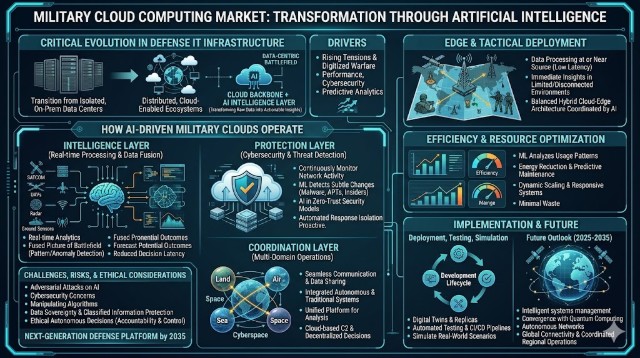
The Military Cloud Computing Market is undergoing a profound transformation as artificial intelligence becomes deeply embedded in defense IT infrastructure. Over the past two decades, military organizations have transitioned from isolated, on-premise data centers toward distributed, cloud-enabled ecosystems capable of handling vast volumes of data generated by modern warfare systems. Today’s battlefield is data-centric, requiring real-time access to intelligence, seamless coordination across multiple domains, and rapid decision-making capabilities. Cloud computing provides the scalable backbone for these operations, while AI acts as the intelligence layer that transforms raw data into actionable insights.
As geopolitical tensions rise and warfare becomes increasingly digitized, the integration of AI into military cloud systems is no longer optional. It is a strategic necessity. AI enhances cloud performance, automates decision-making processes, strengthens cybersecurity, and enables predictive analytics that improve mission outcomes. From battlefield intelligence to cyber defense and multi-domain operations, AI-driven cloud computing is shaping the future of military power between 2025 and 2035.
Introduction to the Military Cloud Computing Market
The military cloud computing market represents a critical evolution in defense infrastructure. Traditionally, military IT systems were siloed, with limited interoperability and restricted data-sharing capabilities. These systems often struggled to keep pace with the growing volume of data generated by modern sensors, drones, satellites, and communication systems. The shift toward cloud computing has enabled defense organizations to centralize and distribute data more efficiently, ensuring that critical information is available whenever and wherever it is needed.
Cloud computing in the military context includes private clouds, hybrid cloud environments, and increasingly multi-cloud strategies. These architectures allow defense agencies to store classified data securely while leveraging commercial cloud technologies for scalability and innovation. The integration of AI into this environment introduces advanced capabilities such as predictive analytics, intelligent automation, and real-time decision support.
The adoption of cloud computing is being driven by the need for faster data processing, improved operational efficiency, and enhanced mission readiness. AI accelerates these benefits by enabling cloud systems to learn from data, adapt to changing conditions, and provide actionable insights that improve decision-making across all levels of military operations.
Request AI Impact Analysis on Military Cloud Computing Industry @ https://www.marketsandmarkets.com/pdfdownloadNew.asp?id=133363531
AI as the Core Driver of Military Cloud Architecture
Artificial intelligence plays a central role in optimizing military cloud infrastructure. Traditional cloud systems rely on predefined rules and manual management, which can limit efficiency in dynamic environments. AI transforms cloud architecture into a self-optimizing ecosystem capable of managing resources, predicting demand, and automating operations.
Machine learning algorithms analyze usage patterns to allocate computing resources more effectively, ensuring that mission-critical applications receive priority access to processing power and storage. AI-driven orchestration enables seamless coordination across distributed cloud environments, allowing military organizations to manage workloads across multiple data centers and geographic locations.
AI enhances virtualization and containerization technologies by optimizing resource utilization and improving system performance. It also enables predictive scaling, where cloud infrastructure automatically adjusts to meet changing demands without human intervention. This capability is particularly important in military operations, where sudden surges in data processing requirements can occur during missions.
The integration of AI into military cloud architecture ensures that systems remain agile, efficient, and capable of supporting complex defense operations.
AI for Real-Time Data Processing and Battlefield Intelligence
Modern warfare generates enormous amounts of data from sensors, surveillance systems, communication networks, and reconnaissance platforms. Processing this data in real time is essential for maintaining situational awareness and making informed decisions. AI-powered cloud systems excel in this area by analyzing data streams as they are generated, providing immediate insights to commanders and decision-makers.
AI enables advanced data fusion, combining information from multiple sources to create a comprehensive picture of the battlefield. This includes integrating data from satellites, drones, radar systems, and ground-based sensors. By analyzing patterns and identifying anomalies, AI helps detect potential threats and predict enemy behavior.
Real-time analytics powered by AI reduces decision latency, allowing military leaders to respond quickly to changing conditions. Predictive models can forecast potential outcomes based on historical data, enabling more effective mission planning and execution. AI-driven cloud platforms also support autonomous intelligence generation, where systems independently analyze data and provide recommendations without human intervention.
This capability significantly enhances operational effectiveness, ensuring that military forces can act decisively and maintain an advantage in complex and fast-moving environments.
AI in Cybersecurity and Threat Detection for Military Clouds
Cybersecurity is one of the most critical aspects of military cloud computing. As defense systems become more interconnected, they also become more vulnerable to cyber threats. AI plays a vital role in protecting military cloud infrastructure by providing advanced threat detection and response capabilities.
AI-driven cybersecurity systems continuously monitor network activity, analyzing patterns to identify anomalies that may indicate potential attacks. Machine learning models can detect subtle changes in behavior that traditional security systems might overlook, enabling early identification of threats such as malware, insider attacks, and advanced persistent threats.
AI enhances zero-trust security models by continuously verifying user identities and monitoring access to sensitive data. Automated response mechanisms allow systems to react to threats in real time, isolating compromised components and preventing the spread of attacks.
Predictive cybersecurity powered by AI helps anticipate potential vulnerabilities and implement preventive measures before they can be exploited. This proactive approach is essential for maintaining the integrity and security of military cloud systems in an increasingly hostile cyber environment.
AI in Multi-Domain Operations and Cloud-Based Warfare
Modern military operations span multiple domains, including land, air, sea, space, and cyberspace. Coordinating activities across these domains requires seamless communication and data sharing. AI-enabled cloud systems facilitate this coordination by providing a unified platform for data integration and analysis.
AI supports multi-domain operations by enabling real-time communication between different military units and platforms. This includes integrating data from autonomous systems, such as drones and unmanned vehicles, with traditional military assets. AI-driven analytics provide insights that help coordinate actions and optimize resource allocation across domains.
Cloud-based command and control systems powered by AI enable decentralized decision-making, allowing units to operate independently while remaining connected to the broader network. This enhances flexibility and resilience, ensuring that operations can continue even if certain communication links are disrupted.
The ability to integrate and analyze data across multiple domains is essential for modern warfare, and AI-powered cloud systems provide the infrastructure needed to achieve this capability.
AI in Edge Computing and Tactical Cloud Environments
Edge computing is becoming increasingly important in military operations, where low latency and real-time processing are critical. AI enhances edge computing by enabling data processing at or near the source, reducing the need to transmit large volumes of data to centralized cloud servers.
In tactical environments, AI-powered edge nodes process data locally, providing immediate insights to soldiers and commanders. This is particularly important in situations where communication with central cloud systems may be limited or disrupted. AI ensures that critical decisions can be made quickly, even in disconnected or contested environments.
Hybrid cloud-edge architectures allow military organizations to balance the benefits of centralized cloud computing with the responsiveness of edge processing. AI coordinates these systems, ensuring that data is processed in the most efficient location based on mission requirements.
This integration of AI, edge computing, and cloud infrastructure enhances operational resilience and enables more effective decision-making in dynamic and challenging environments.
AI for Resource Optimization and Cloud Efficiency
Efficient use of resources is essential for maintaining the performance and sustainability of military cloud systems. AI plays a key role in optimizing resource allocation, ensuring that computing power, storage, and energy are used effectively.
Machine learning algorithms analyze usage patterns to identify inefficiencies and recommend improvements. AI-driven optimization reduces energy consumption, lowers operational costs, and improves system performance. This is particularly important for large-scale data centers supporting military operations.
AI enables dynamic scaling, where cloud resources are adjusted automatically based on demand. This ensures that systems remain responsive during peak usage while minimizing waste during periods of lower activity. Predictive maintenance powered by AI helps prevent system failures, reducing downtime and improving reliability.
By optimizing resource utilization, AI ensures that military cloud systems can support complex operations while maintaining efficiency and sustainability.
AI in Military Cloud Deployment, Testing, and Simulation
The deployment and testing of military cloud systems require rigorous validation to ensure reliability and security. AI enhances these processes by automating testing, identifying potential issues, and improving system performance.
Digital twins powered by AI create virtual replicas of cloud environments, allowing engineers to simulate real-world scenarios and test system behavior under different conditions. This reduces the need for physical testing and accelerates development cycles.
AI-driven continuous integration and deployment pipelines ensure that updates and new features are implemented smoothly without disrupting operations. Automated debugging and performance optimization improve system stability and reduce the risk of errors.
Simulation tools powered by AI enable military organizations to test cloud systems in complex scenarios, ensuring that they can perform effectively under real-world conditions. This capability is essential for maintaining the reliability and security of mission-critical systems.
Challenges, Risks, and Ethical Considerations
While AI offers significant benefits, it also introduces challenges and risks that must be addressed. Cybersecurity remains a major concern, as AI-driven systems can be targeted by adversarial attacks designed to exploit vulnerabilities or manipulate algorithms.
Data sovereignty and the protection of classified information are critical issues in military cloud computing. Ensuring that sensitive data is stored and processed securely is essential for maintaining national security.
Ethical considerations also arise from the use of AI in military operations. The potential for autonomous decision-making raises questions about accountability and control. Ensuring that AI systems operate within established ethical frameworks is essential for maintaining trust and compliance with international regulations.
Addressing these challenges requires a comprehensive approach that includes robust security measures, clear governance frameworks, and ongoing oversight.
Future Outlook: AI-Powered Military Cloud Ecosystem by 2035
By 2035, AI will be fully integrated into military cloud computing, creating intelligent systems capable of managing complex operations autonomously. These systems will provide real-time insights, support decision-making, and enhance operational efficiency across all domains.
The integration of AI with emerging technologies such as quantum computing and advanced analytics will further enhance the capabilities of military cloud systems. Autonomous networks will be able to adapt to changing conditions, optimize performance, and maintain security without human intervention.
AI-driven cloud ecosystems will enable global connectivity, supporting coordinated operations across multiple regions and domains. This will enhance the ability of military forces to respond to threats quickly and effectively.
The future of military cloud computing lies in the convergence of AI, data, and advanced infrastructure, creating a powerful platform for next-generation defense operations.
Related Report:

This FREE sample includes market data points, ranging from trend analyses to market estimates & forecasts. See for yourself.
SEND ME A FREE SAMPLE





